
Managing TV screen menu boards across dozens or even hundreds of franchise locations isn’t just about replacing paper with pixels.
It’s about orchestrating brand consistency, maintaining regulatory compliance, responding to market dynamics in real time, and empowering local operators while keeping corporate standards intact.
Multi-location digital menu board management presents unique challenges including brand consistency across diverse markets, centralized control with local flexibility, and scalable operations supporting rapid growth.
Restaurant chains using advanced digital menu board software report significant improvement in operational efficiency.
If you’re struggling with inconsistent pricing across locations, delayed menu updates, compliance headaches, or franchisees going rogue with unauthorized changes on their digital menu boards, you’re not alone.
Let’s explore the proven strategies that successful brands follow to manage a digital display menu for franchise networks effectively.
The Hidden Costs of Poor Menu Management
Before diving into solutions, let’s acknowledge what’s at stake. The challenges go far beyond outdated paper menus and USB drives used for updating TV menu manually.
1. Brand Inconsistency Erodes Customer Trust
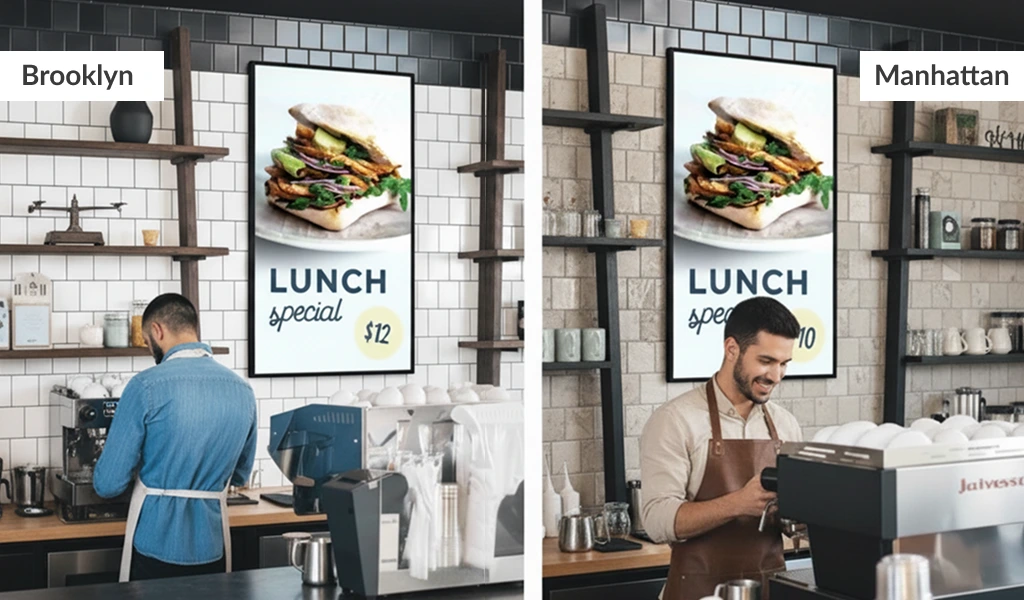
More than 50% of business comes from repeat customers, and consistency is everything. When a customer orders a “Lunch special” at one location for $10 and sees it priced at $12 on the menu at another location, trust breaks down immediately.
The real issue: Many restaurant chains struggle to maintain consistent content across their digital menu boards, resulting in customer confusion and frustration.
This inconsistency extends beyond pricing – outdated promotions, mismatched nutrition facts, or discontinued items still appearing on digital menu boards all contribute to poor customer experiences.
2. Dynamic Pricing Demands Real-Time Agility
Franchise operators now update digital menu boards at least four times a year to keep up with rising ingredient costs – much more frequently than in the past.
Inflation, supply chain volatility, and seasonal product availability require up-to-date pricing. When price adjustments take weeks to roll out across restaurant menu display, franchises lose significant revenue.
Two weeks of delay across hundreds of TV screen menu means thousands in profit left on the table.
3. Operational Inefficiencies Drain Resources
Manual processes for updating restaurant TV menu create hidden costs:
- Corporate staff creating multiple versions of the same menu
- Franchisees waiting for approvals to update their digital menu boards
- IT teams reacting to screen failures only after complaints
- Marketing teams recreating assets due to disorganized file storage
- Staff losing time adjusting daypart schedules manually
At scale, this creates major inefficiency.
4. Missed Revenue Opportunities from Static Digital Menu Boards
Competitors using dynamic content on menu screen are driving higher revenue, while outdated or static screens limit opportunities:
- No automatic transitions from breakfast to lunch
- Lost happy hour or weather-based promotions
- No inventory-based content adjustments
- Delays in displaying limited-time offers
Modern digital menu boards can update automatically based on time, weather, or demand – if you have the right system.
Best Practice #1: Use Centralized Cloud-Based Menu Management for Franchise Menu Boards
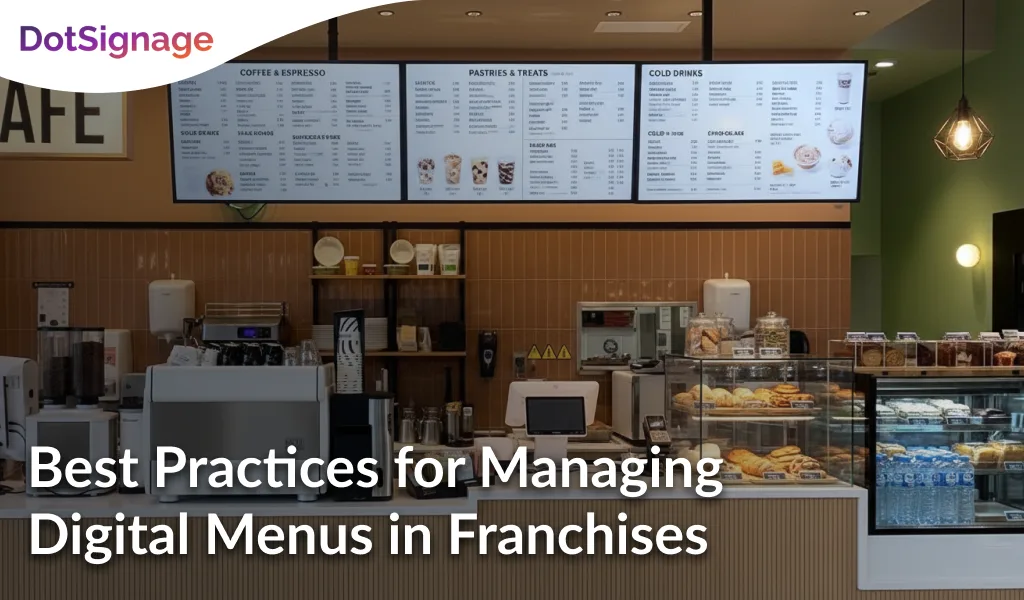
The foundation of successful multi-location menu management is a cloud-based content management system (CMS) that enables centralized control with distributed flexibility.
Why Cloud-Based Solutions Win
Cloud-based digital signage solutions reduce deployment costs by up to 40% compared to traditional methods. For multi-location restaurant digital menu boards, cloud systems make scaling and managing menus across dozens or hundreds of locations far more efficient. Beyond cost savings, cloud platforms deliver:
Instant Updates Across All Locations
A single update, requiring no more effort than it would take for one location, can be rolled out statewide or nationwide, as menus no longer needs to be created, printed, shipped, and manually updated at each branch.
With the easy to use cloud-based platform of DotSignage, when your supply chain partner notifies you of a price increase on chicken, you can update the digital menu board pricing across 200 locations in minutes, not weeks.
When corporate launches a new seasonal LTO, every franchise can start promoting it simultaneously.
Real-Time Performance Monitoring
Cloud dashboards give corporate visibility into what’s displayed at every location, right now. You can instantly identify:
- Which locations haven’t updated to the new menu template on digital menu boards
- Screens that are offline or malfunctioning
- Locations displaying unauthorized content
Role-Based Permissions for Controlled Flexibility
Assign specific menu management rights to different staff or managers across franchises securely, controlling menu modification permissions based on designated roles within the organization.
Template Standardization: The Starting Point
Standardized templates keep digital menu boards brand-consistent while allowing controlled local customization.
With DotSignage, franchisors can:
- Create master menu templates
- Lock colors, fonts, and layout elements
- Allow location-specific text or image updates
- Automate pricing from a central database
Corporate designs once, every digital menu board stays compliant everywhere.
Best Practice #2: Master Dayparting for Maximum Revenue Impact

Dayparting means content automation, as restaurants create schedules for their menus and advertisements allowing automatic content rotation.
Rather than displaying the same menu 24/7, dayparting optimizes content for different times of day and days of the week.
Why Dayparting Matters
Customer Expectations Have Shifted
At 7 AM, customers expect to see breakfast items prominently featured. At 2 PM, they’re looking for lunch, combos or snacks. At 9 PM, late-night value meals should take center stage.
Dayparting improves customer experience by ensuring menu items are relevant to the time of day, leading to increased customer satisfaction and encouraging repeat business.
Revenue Opportunity Is Significant
Targeted promotions and dynamic pricing across digital menu boards during peak times can drive sales and increase average order values. Strategic dayparting enables:
- Breakfast rush upsells (premium coffee drinks before 10 AM)
- Lunch combo promotions (11:30 AM – 1:30 PM)
- Afternoon snacking opportunities (2 PM – 5 PM)
- Dinner family meal deals (5 PM – 8 PM)
- Late-night munchies specials (after 9 PM)
Implementing Effective Dayparting with DotSignage
Create Time-Appropriate Content
Implementing dayparting strategies requires careful planning to analyze customer behavior patterns, sales data, and menu performance to identify the most appropriate menu items and promotions for each time segment.
Using the playlist feature of DotSignage, you can create distinct digital menu board layouts for each daypart. For example, a restaurant can use a pizza menu template during lunch and dinner hours to highlight popular pizza combinations, toppings, and meal deals.
- Breakfast (6 AM – 10:30 AM): Feature breakfast pizzas, coffee, bakery items, and quick grab-and-go options for café-style or early-morning pizza restaurant customers.
- Lunch (10:30 AM – 2 PM): Highlight personal pizzas, slices, lunch combos, and fast meal deals designed for office workers and quick-service diners.
- Afternoon (2 PM – 5 PM): Promote snacks, garlic bread, beverages, dessert items, and smaller portions for lighter afternoon orders.
- Dinner (5 PM – 9 PM): Showcase family pizza deals, specialty pizzas, premium toppings, and combo offers using a pizza menu template that highlights your most profitable items.
- Late Night (9 PM – Close): Focus on value combos, shareable pizzas, delivery specials, and late-night snack options popular with delivery and takeout customers.
Automate Everything
Manual dayparting defeats the purpose. The scheduling capabilities of DotSignage allow you to schedule content day-wise and time-wise, automatically:
- Switching menus at predetermined times across all locations
- Adjusting for location-specific hours (some franchises close earlier)
- Overriding regular schedules for special events (holiday hours, local festivals)
- Reverting to default programming if custom schedules expire
Create your breakfast, lunch, and dinner playlists once in DotSignage, set your schedule, and let the system handle the transitions automatically. No manual intervention is required. Your franchisees can focus on serving customers while DotSignage ensures the right menu appears at the right time, every time.
Best Practice #3: Balance Brand Consistency with Local Flexibility
Maintaining brand integrity while enabling location-level customization is essential for franchise success – especially on digital menu boards.
DotSignage solves this with:
- Locked master templates
- Customizable local elements
- Automated schedules
- Permission-controlled edits
Whether customers visit Denver or Dallas, they experience the same brand on your menu display while enjoying relevant local content.
Implementing Your Digital Menu Management System: A Phased Approach
Don’t try to boil the ocean. Successful implementations follow a phased approach.
Phase 1: Foundation (Months 1-2)
Define Requirements and Select Platform
- Document current pain points and desired outcomes
- Evaluate platforms against requirements (template flexibility, scheduling capabilities, ease of use)
- Run proof-of-concept at 2-3 pilot locations
- Select vendor and finalize contract
Establish Governance
- Create digital menu management policy document
- Define roles and responsibilities
- Build approval workflows
- Set content standards and brand guidelines
Phase 2: Pilot (Months 3-4)
Deploy to Pilot Locations
- Install hardware at 5-10 representative locations
- Train pilot franchisees on template editor and scheduling features
- Test all workflows and integrations
- Gather feedback and refine processes
Create Content Library
- Build master templates using the template editor
- Create initial menu content and playlists for different dayparts
- Develop promotional asset library
- Document content creation processes
Phase 3: Rollout (Months 5-8)
Phased Deployment
- Roll out to locations in waves (25% per month)
- Prioritize high-volume or high-visibility locations first
- Conduct regional training sessions on playlist creation and scheduling
- Provide extra support during initial weeks
Optimization
- Address issues rapidly
- Refine templates based on real-world performance
- Share early wins to build momentum
Phase 4: Maturity (Months 9-12)
Complete Deployment
- Finish rollout to remaining locations
- Ensure all franchisees are trained and comfortable
- Decommission legacy systems
- Full integration with all systems
Real-World Success: What's Possible
When franchise brands get digital menu management right with platforms like DotSignage, the results speak for themselves. A good example can be seen in the Greek Xpress digital menu board deployment case study, where centralized menu management helped streamline updates across locations and improve operational efficiency.
Operational Excellence: Restaurant chains using advanced multi-location digital menu systems report improvement in operational efficiency and reduction in menu management costs. The intuitive interface of DotSignage means less training time and faster content updates.
Consistency at Scale: Modern digital signage software makes it easy to manage the health of a franchise’s screens, with central IT departments receiving notifications whenever a screen fails, differing from only hearing about failures after customer or employee complaints.
Revenue Growth: Among consumers who noticed digital billboards, 93% who visited the business made a purchase, and targeted promotions through digital display menu to drive measurable increases in average order value. With the scheduling and playlist features of DotSignage, franchises can automatically promote high-margin items during peak hours.
Franchisee Satisfaction: When franchisees have the tools to succeed in their local markets while staying within brand guidelines, satisfaction and renewal rates increase substantially. DotSignage empowers local operators while maintaining corporate oversight.
The Path Forward
Managing digital menu boards across a franchise can seem complicated, but it becomes much easier with the right approach. It starts with choosing technology, such as flexible, centralized platforms like DotSignage, that provides strong oversight while still giving individual locations room to adapt.
Clear guidelines then help everyone understand what must remain consistent and what can be customized. When your menu system connects seamlessly with the rest of your technology, everything runs more smoothly.
Add proper training so franchisees know how to use the tools and keep refining the system using real data and insights.
Franchises that do this well gain a lasting advantage. They operate more efficiently, maintain a strong and consistent brand, and stay agile in a fast-changing market, all by mastering digital menu management.
If you and your team are looking to transform menu management for your restaurant chain, reach out at info@dotsignage.com or schedule a call with us.

Get the Best of Digital Menu Boards at Just $10!
No Credit Card Required

About Smit
Smit Nebhwani, a tech entrepreneur with over a decade of experience, specializes in building successful SaaS products. An authority in digital signage, he shares valuable industry insights through his content. In his free time, he enjoys music, traveling, and family time.
Share this post: